What Your Employee Benefits Reveal About What You Believe About the Human Person
by Jason Coon
We May Be Asking the Wrong Questions
Over the past year, I’ve had the privilege of reviewing dozens of health plans for Catholic employers across the country. Every review is a little different, but one realization keeps surfacing.
Most Catholic employers have spent years thinking deeply about their mission. They invest in Catholic education, pastoral care, faith formation, service to the poor, and building a culture rooted in the Gospel. They work hard to ensure their organizations reflect the teachings of the Church in the way they lead, hire, and serve others.
Yet one of the largest investments they make every year often escapes that same level of intentional reflection.
Their employee health plan.
For many organizations, the health plan is simply something that has evolved over time. A broker makes recommendations. A carrier updates language. A third-party administrator adopts new provisions. The plan renews each year, and everyone assumes that because the employer is Catholic, the health plan naturally reflects Catholic values.
Our experience has shown that this assumption is rarely tested.
That observation has led me to ask a different question. Rather than beginning with cost, compliance, or employee satisfaction, what if we began with something much more fundamental?
What does our health plan say about the human person?
Every Health Plan Tells a Story
At first glance, that may seem like an unusual question to ask about employee benefits. But the more we’ve studied health plans through our CARLO reviews, the more convinced I’ve become that it is the most important question of all.
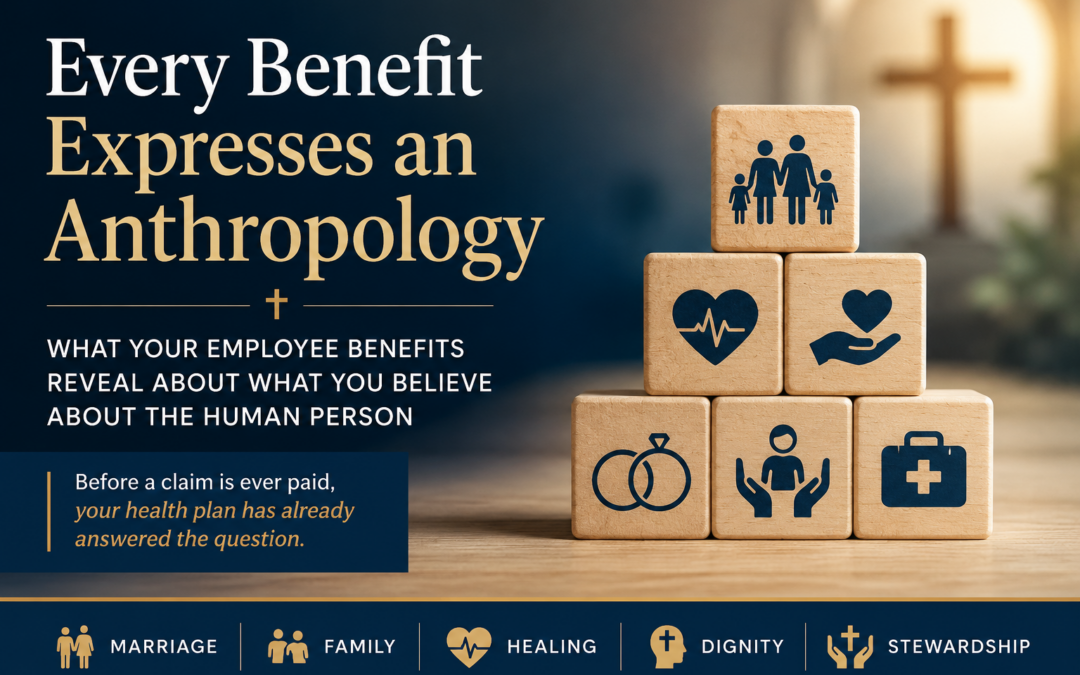
Every health plan is built upon assumptions. Those assumptions influence what is covered, what is excluded, what is encouraged, and what is discouraged. In other words, every benefit expresses an understanding of what it means to be human.
Before a health plan ever pays a claim, it has already communicated a vision of marriage, family, medicine, suffering, and human flourishing.
Whether we intended it or not, every health plan tells a story.
The Questions Hidden Inside Every Benefit
Consider just a few of the questions every health plan answers.
- What is marriage?
- What is family?
- What is fertility?
- What is the purpose of medicine?
- When should healthcare restore the body, and when should it alter it?
- How should employers care for employees during illness, disability, infertility, pregnancy, mental health struggles, or the end of life?
These are not simply coverage decisions.
They are questions of anthropology. They reveal what we believe about the dignity of the human person and the purpose of healthcare itself.
Take fertility as one example.
A health plan can treat fertility as a healthy function of the human body that should be understood, respected, and restored when something is wrong. Or it can treat fertility primarily as an obstacle to avoid or a condition to manipulate through technology. Those two approaches are built upon very different understandings of the human person.
The same is true for marriage and family. Benefit designs communicate whether children are welcomed as gifts, whether spouses are supported in their vocation, and whether families are strengthened during some of the most important moments of life.
Even our understanding of medicine is reflected in the choices we make. Is medicine ordered toward healing and restoring the person? Or has it become primarily a means of overcoming every natural limit through technological intervention?
Every health plan answers those questions, whether intentionally or not.
What We’ve Learned Through CARLO
One of the most interesting discoveries from our reviews is that many of these decisions were never consciously made by the Catholic employer. The language often originated years ago with a carrier, a template, or a third-party administrator. Over time, provisions were added, modified, or expanded without anyone stopping to ask whether they still reflected the mission of the organization.
That is why we have often said that alignment cannot be assumed.
A Catholic employer may have a deeply Catholic mission while operating a health plan that quietly communicates a very different understanding of the human person. Not because anyone intended it, but because no one was actively governing it.
I’ve come to believe that this is one of the greatest stewardship opportunities facing Catholic employers today.
From Compliance to Stewardship
This is one of the reasons we have begun talking less about compliance and more about stewardship.
Compliance asks whether a health plan satisfies legal requirements.
Stewardship asks whether the plan faithfully reflects the mission entrusted to the organization.
Those are very different conversations.
As Catholic employers, we rightly devote time and attention to our mission statements, strategic plans, hiring practices, and organizational culture. We understand that these things shape who we are.
Our employee benefits deserve that same level of intentional leadership.
One of Your Most Important Ministries
Health plans are not merely financial arrangements. They become deeply personal at precisely the moments when employees are most vulnerable.
They accompany newly married couples.
Parents welcoming children.
Families facing infertility.
Employees battling cancer.
Someone struggling with depression or anxiety.
A family walking with a loved one through the end of life.
In those moments, the health plan does much more than process claims.
It communicates values.
It shapes expectations.
It teaches employees what the organization believes healthcare is for and what it means to care for another human being.
Perhaps we’ve underestimated the ministry of employee benefits.
A Question Worth Asking
Mission statements matter.
Formation matters.
Leadership matters.
Culture matters.
But if one of the largest investments we make in our employees is quietly communicating a different story about the human person, then our work is not yet complete.
Perhaps the question every Catholic employer should begin asking is not simply, “Is our health plan competitive?” or even, “Is our health plan compliant?”
Perhaps the better question is this:
If someone read nothing about our organization except our employee benefits, what would they conclude we believe about the human person?
That is not simply an insurance question.
It is a stewardship question.
It is a leadership question.
And ultimately, it is a profoundly Catholic question.
Every health plan is catechizing someone. The only question is whether it is teaching the truth about the human person.