by Jason Coon
What we are learning as Catholic employers take a closer look at whether their health plans reflect their mission
Catholic employers spend significant time thinking about mission. We consider how our schools, healthcare organizations, ministries and businesses reflect a Catholic understanding of the human person. We invest in formation, policies and leadership intended to protect and strengthen that identity.
Employee benefits deserve the same attention.
For many organizations, the health plan is one of their largest investments in employees and their families. Yet it is also extraordinarily complex. Plan language develops over years. Vendors change. Regulations change. New services enter the healthcare marketplace. Somewhere along the way, it becomes easy to assume that a health plan continues to reflect the values and intentions of the organization sponsoring it.
Our experience suggests that assumption is worth testing.
What Is a Stewardship Review?
The Catholic Benefits Association developed Stewardship Reviews to help Catholic employers take a more intentional look at whether their health plans reflect their mission. legal protections and Catholic identity.
The review looks beyond traditional questions of cost and compliance to identify areas of potential concern, opportunities for greater alignment, and ways an organization can more intentionally steward the benefits it provides to employees and their families.
Findings are prioritized by significance—from Critical and High concerns requiring greater attention to Medium and Low findings that may represent opportunities for clarification or improvement. The goal is not simply to produce a score or a list of issues. It is to give Catholic employers a clearer picture of where their plan stands and a practical starting point for improvement.
What the Reviews Are Showing Us
Across a recent sample of 35 policies, our Stewardship Reviews identified findings involving contraception, sterilization, reproductive services, gender-related services and other areas where health plan design intersects with Catholic teaching and religious liberty protections.
Across the ten most common finding categories, the initial reviews identified:
82 Critical findings
18 High findings
6 Medium findings
Those numbers are significant. But they aren’t the most important part of the story.
What happened next is.
Organizations took their findings back to leadership teams, consultants, carriers and other benefit partners. They asked questions, reconsidered provisions, clarified language and submitted revised plan documents for another review.
Among the corrected documents we reviewed:
-
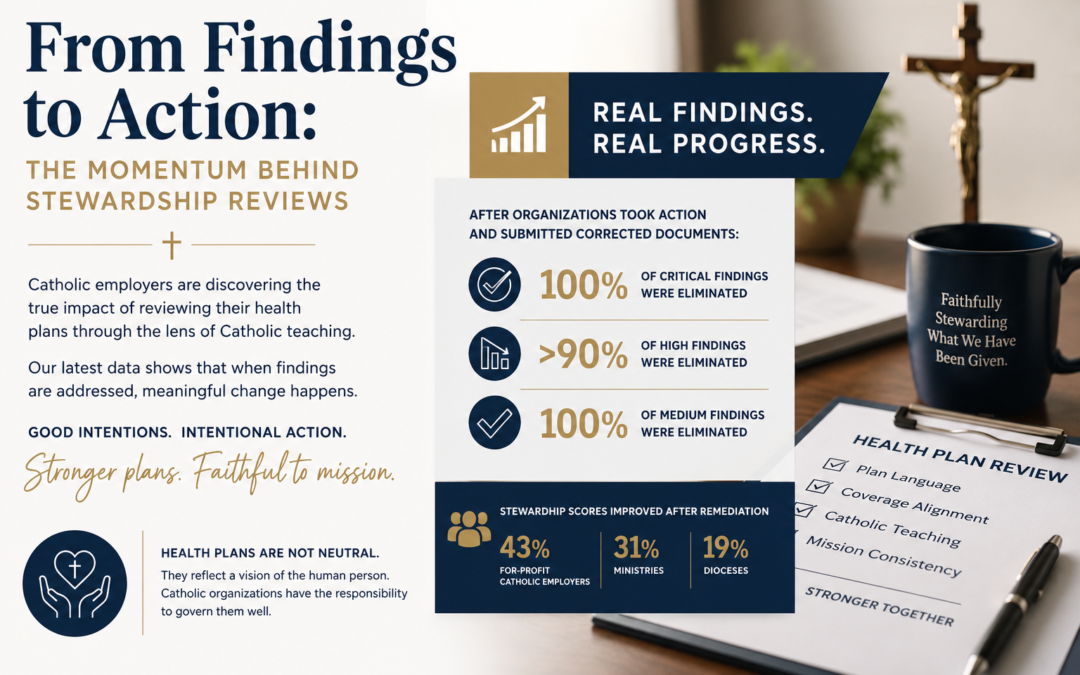
100% of Critical findings were eliminated
-
More than 90% of High findings were eliminated
-
100% of Medium findings were eliminated
Most of what remained involved Low findings or additional opportunities for clarification and stronger Catholic identity.
That is the momentum behind Stewardship Reviews. We aren’t simply identifying issues. Catholic employers are addressing them.
A Finding Isn’t Necessarily a Failure
It would be easy to look at 82 Critical findings and conclude that Catholic employers are doing something wrong. Our experience suggests a more complicated—and more encouraging—story.
Many of the issues we identify are not the result of an organization consciously deciding to depart from Catholic teaching. Often, they arise from the complexity of the healthcare marketplace and the challenge of translating Catholic teaching and hard-won religious liberty protections into actual plan administration.
An employer may inherit standard carrier language. A TPA may update a template. A pharmacy arrangement may change. A new medical service may fall within an existing benefit category. An SPD may contain language that has simply been carried forward year after year without anyone asking whether it still reflects the organization’s intentions.
The problem is often not a lack of Catholic conviction. It is that complex health plans require intentional stewardship.
And once organizations understand what their documents actually say, we are seeing a strong willingness to act.
The Improvement Can Be Measured
The remediation work is now allowing us to measure that progress.
Among organizations that submitted corrected documents, for-profit Catholic employers improved their scores by an average of 43%, ministries by 31%, and dioceses by 19%.
The percentages are encouraging, but the decisions behind them matter more.
A provision was questioned. Coverage was clarified. An exclusion was strengthened. A consultant was asked to revisit a recommendation. A carrier or TPA was asked to make a change. Leadership became involved in a benefit decision that may previously have been viewed primarily as an HR or insurance matter.
This is where stewardship can begin to shape governance.
Stewardship is the larger responsibility: faithfully caring for the health plan and the resources entrusted to the organization. Governance helps make that responsibility durable by determining who is accountable, how important benefit decisions are made and how alignment is maintained over time.
The Stewardship Review helps identify where attention may be needed. Remediation addresses what was found. Good governance helps preserve that progress.
Health Plans Are Not Neutral
There is a larger lesson emerging from this work.
Every health plan makes decisions about what constitutes healthcare, what medicine is intended to accomplish and which services an employer will financially support. Those decisions inevitably reflect an understanding of the human person.
For a Catholic employer, that matters.
In his recent encyclical Magnifica Humanitas, Pope Leo XIV addresses the rapid growth of technology and artificial intelligence, but one of the principles he articulates reaches much further. When considering the powerful systems shaping modern life, he writes that “the key issue is not the use of technology as such, but the vision that underlies it.”
That raises an important question for healthcare as well:
What vision of the human person underlies our health plans?
Catholic organizations operate from a particular understanding of human dignity, marriage, family, fertility and the purpose of healthcare. Those convictions should not disappear when an organization moves from its mission statement to its employee benefit plan.
Yet without intentional stewardship, the assumptions of the broader healthcare marketplace can quietly become embedded in the plan. Standard carrier language, benefit designs, pharmacy arrangements and new medical technologies can all bring with them judgments about what constitutes health, what medicine should accomplish and ultimately what it means for a person to flourish.
That is why health plans are not neutral.
The question is not whether a health plan expresses a set of values. The question is whether those values have been chosen intentionally by the organization or inherited unintentionally from the marketplace.
Our Stewardship Review findings suggest this is not merely a theoretical concern. When Catholic employers examine what is actually contained in their plans, identify areas of misalignment and intentionally correct them, they are doing more than improving a score.
They are exercising stewardship over one of the most significant ways they care for their employees and families.
Stewardship Doesn’t End With the Review
A Stewardship Review provides an important snapshot, but the work cannot end there.
Health plans continue to change. Vendors change. Contracts change. New benefits are introduced. Regulations evolve. Plan amendments are adopted. A plan that is well aligned today cannot simply be assumed to remain aligned indefinitely.
This is where good governance supports stewardship.
Who is responsible for reviewing significant plan changes? What authority has been delegated to consultants, carriers, TPAs and PBMs? When a new benefit is recommended, who considers whether it is consistent with Catholic teaching? And when a concern is identified, who is responsible for seeing it through to resolution?
These are governance questions, but they serve a larger purpose: helping an organization remain a faithful steward of its health plan over time.
There Is Reason for Optimism
Perhaps the most encouraging lesson from these early results is that Catholic employers can influence their health plans.
The healthcare marketplace is complicated, and Catholic organizations sometimes encounter real limitations with carriers, TPAs, PBMs and other benefit partners. But the remediation results demonstrate that meaningful change is possible.
Thirty-five policies reviewed. Eighty-two Critical findings identified. Every Critical finding eliminated among the corrected versions reviewed. High findings reduced by more than 90%. Medium findings eliminated. Meaningful score improvement across Catholic ministries, dioceses and businesses.
That is not simply a story about finding problems.
It is evidence of what can happen when Catholic employers take greater ownership of their health plans.
For organizations already participating in Stewardship Reviews, the next step is to act on the findings, submit corrected documents for a rescore and consider how that progress will be maintained.
For Catholic employers encountering this work for the first time, the starting question is equally simple:
Does our health plan actually reflect who we say we are?
A Stewardship Review can help answer that question.
The review tells us where we are. Remediation moves us forward. Governance helps us maintain the progress. And all three serve the larger responsibility of stewardship.